

Vinyl flooring has long been a traditional specification choice within our education buildings. However, with the market demanding more sustainable solutions, how does vinyl stack up? Donna Hannaway, Head of Marketing UK and Ireland at Forbo Flooring, explores how modern viny can deliver on the need for greener interiors ACROSS the UK, schools are working towards significant carbon reduction targets, all driven by the Department for Education’s (DfE) strategy aiming for net zero by 2050, with an interim goal of a 75% cut by 2037. The end of 2025 saw the deadline for all schools to nominate a Sustainability Lead and set out their Climate Action Plan (CAP), designed to detail steps for energy efficiency and waste reduction, amongst others. Campaigns like Let’s Go Zero are taking this a step further, encouraging schools to become zero-carbon by 2030.
Against this landscape is the unavoidable fact that schools and colleges are incredibly busy and high traffic environments, facing growing class sizes and extensive daily wear and tear. As such, interior refurbishments are a common occurrence, taking place during school holidays to avoid downtime or disruption to learning. This makes it important to choose carefully when it comes to building products and materials, contributing to greener interiors that don’t compromise on design, function or material longevity.
Take flooring as an example, one of the largest surface areas in any building. While carpet tiles are a common choice for classrooms, a harder wearing, resilient flooring (such as vinyl) is ideal for busy communal spaces, such as corridors and hallways. Vinyl may offer excellent durability and cleanability; yet, it has never had a particularly positive perception amongst the market as a sustainable solution. However, this could all be about to change, thanks to new manufacturing innovations.
Typically, vinyl is manufactured from PVC, a versatile and widely used thermoplastic polymer that is commonly derived from salt and oil or gas. Today, tasked with contributing to a greener built environment, some flooring manufacturers are getting innovative with material sourcing. A great example is the incorporation of bio-based materials (such as used cooking oil) within the PVC itself, helping to significantly lower the embodied carbon of the vinyl floor covering. As well as bio-based materials, it’s also worthwhile looking for vinyl that contains a large percentage of recycled content.
Of course, you can’t talk about sustainability without also considering a product’s expected lifespan. Vinyl flooring offers long-term durability with excellent dimensional stability, while its hygienic and non-porous surface allows for easy cleaning, avoiding over-reliance on harsh chemicals. Some vinyl solutions even include a smart topcoat, which can offer further protection against chemicals, scratches and stains.
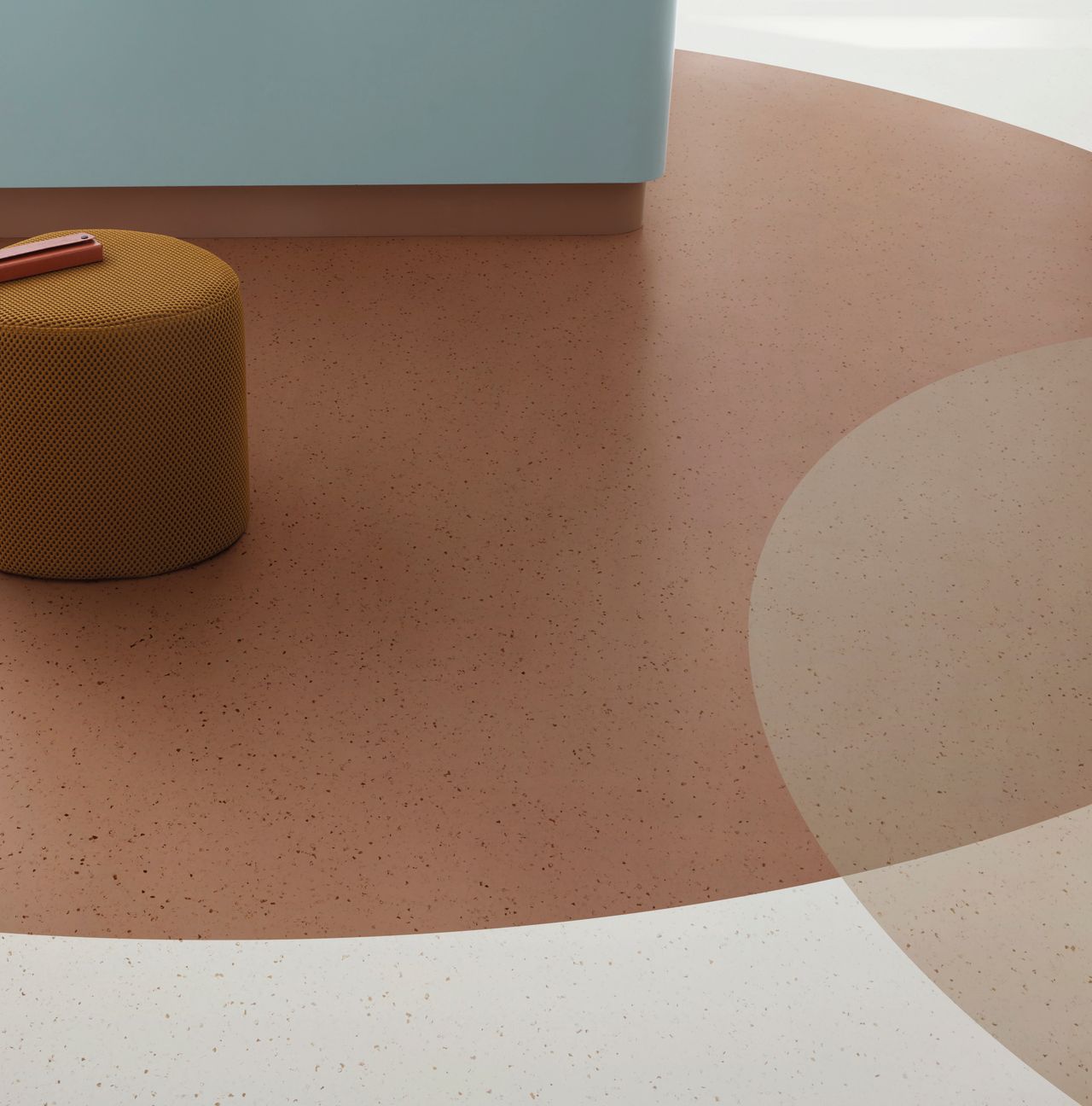
For example, Forbo recently launched its new Sphera Elite b+ collection of homogeneous vinyl. With an impressive 50% reduction in embodied carbon compared to the standard Sphera range and the incorporation of 43% recycled and biobased content - the latter coming mainly from recycled cooking oil, avoiding the use of fossil raw materials or palm oil - the range is designed and manufactured in Europe at a zero-waste facility using 100% renewable electricity. Forbo’s wider Sphera vinyl collection was the product of choice for The Rotterdam Business School, specified alongside other flooring finishes within the Grand Café. Designed to offer an inspiring, flexible and sustainable educational environment, the 14,000m2 building houses as many as 10,000 students who are training to become the economists and business experts of the future. Specified in Shimmer Masala and Shimmer Concrete, Sphera Energetic was chosen by designers for the playful combination of colours and the added benefit that the product was manufactured in the Netherlands within a Zero Waste factory.